Historic & Mythological Tales
Black Magic Stories: from Africa Ninki Nanka, Part 1
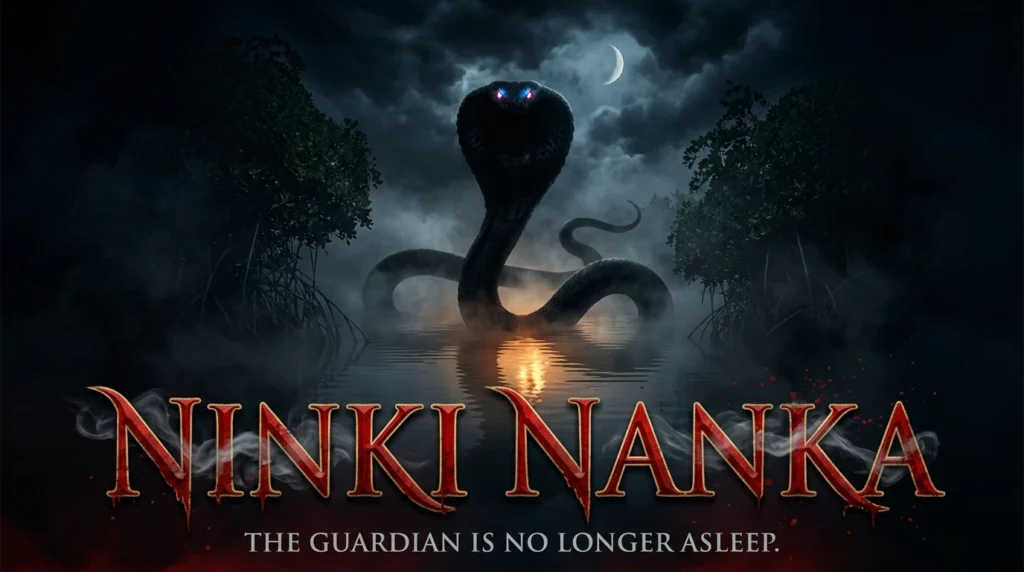
This is the first part of one of the most frightening ancient black magic stories from Africa that I have ever heard.
The Night the Jinn Fell
The sky over the Gambian coast had turned black that night, for some unknown reason. Clouds covered all of it, and only a thin sliver of pale moon showed through. In its faint light, a salty wind cut through the heart of the forest, and it felt strangely mysterious. Everything around was heavy and still. As if sensing the dark omen of a terrible storm, nature had gone silent.
After a day of exhausting work and an out-of-season session of intense spiritual practice, Bagla Dadu’s worn-out body had collapsed onto his bed. Just as his eyelids were sinking into deep sleep, he was jolted awake by a hideous sound. The raised floor of his native doctor’s hut and the ground around it shook violently, as if some ancient monster were trying to rise from beneath the earth. He sat up in a rush. Tiredness mixed with sharp irritation in his eyes, and the alertness of an experienced sorcerer. He listened. Something was making a strange noise outside, like a venomous snake dragging a helpless frog down into itself, the choking, ghoulish groan of a creature that cannot breathe.
“Who is it? Who has the nerve to come into my territory and make trouble?” Dadu’s deep, heavy voice tore through the silent night. No answer came. Instead there was the sound of struggling, and the strange tremor from under the ground grew a thousand times stronger. He could not stay still any longer. He pushed the door open and stepped into the yard, and a hellish scene appeared before his eyes.
A huge shape made of pitch-black shadow, its body as long and crooked as some monstrous great serpent, was hurling itself in wild fury at his pet guardian jinn. These powerful jinn, tamed through long years of practice, never gave way to any dark force. Now they were being flung aside like straw with every lash of this monstrous power. In a moment the air changed. It grew thick with a foul stench and the smell of burning flesh. Dadu muttered, “What new curse is this?”
He hurried back into the hut and groped in the dark for his old leather bag. From it he took a string of prayer beads made of consecrated elephant bone, and a special root wrapped in red cloth. When he came outside, he saw the monster lift his last guardian jinn into the air and slam it against the ground. Bagla Dadu planted his feet firmly on the earth. Then, in a deep voice, he began to chant in an ancient African language. His heavy voice roared across the stillness of the night. Under the force of the chant, a bluish glow like fire spread from the red root in his hand.
The moment that blue light touched it, the monstrous shadow froze for an instant. It left the jinn alone and fixed its gaze on Dadu, its burning, blood-red eyes seeming to pierce right through his soul. But Dadu was an experienced man, and he was not one to give in. The next moment, with a deafening hiss that shook sky and earth, the shadow serpent spread a huge hood and lunged straight at him. There was no hesitation in its rushing body. There was only rage and the pure will to destroy.
Dadu’s feet felt rooted in the ground like an old baobab. The shadow was only a few arm-lengths away. The hot, rotten-flesh stench pouring from its huge open mouth was choking him, but he did not move an inch. The root burned fiercely. The chant did not stop on his lips, and the rattle of his prayer beads kept sounding. Right in front of his face, the serpent suddenly stopped. Dadu’s body trembled slightly with the force of the chant. The snake now looked with burning eyes at the root in his hand. Then, out of that deep darkness, came a mechanical, grating laugh. It was not an animal’s. It was like the sound of some old, rusted machine breaking down. The laugh echoed through the stillness of the night.
A Demand Made in the Dark
From that shadow came an unnatural, metallic voice, full of contempt. “I did not come to harm you.”
At these unexpected words, Dadu’s chanting stopped. His experienced eyes blinked. In all his years of practice he had faced many tricks, and he was not one to trust easily. Frowning, he asked in a grave voice, “Who? Who are you? You attack my guardian jinn and say you did not come to harm me! What do you want?”
The shadow twisted once, as if in pain. Its metallic voice grew sharper and more desperate. “Freedom! I want freedom from the Jora Chhayar Maya, the Twin Shadow Spell.”
“The Twin Shadow Spell!” The moment he heard the name, Dadu’s chest lurched. An old memory flashed through his mind like lightning. Long ago, he and Lala Dadu together had bound a terrible water monster in the net of this very spell. That monster had emptied the laps of many mothers along the banks of the Gambia River. Could this be that monster? How had it broken the net of the spell? Deep lines of worry cut across Dadu’s forehead. He had still not lowered the root in his hand, but his astonishment and suspicion had now overtaken even his fear of the monster. “Are you that water monster?” His voice was a mix of curiosity and unknown fear. “But breaking that spell is impossible. How did you do it?”
For a moment the shadow serpent swelled larger and blacker. The air around them turned colder. “You do not need to know the answer. Sorcerer, the two of you together bound me. Now tell me, will you set me free, or do you want to watch me devour this hut and this whole village?”
Dadu’s heart pounded like a hammer. Face to face with this freezing darkness, he understood clearly that no spell or root would subdue this monster today. If he tried to use force, his carefully raised jinn and the existence of the whole region would be wiped out forever. Whatever he did, he would have to do it with cleverness.
The living blue light in his hand slowly faded. In the hut, the long shape of the shadow swayed. He stepped back once. The hard lines of his face broke, and an unfinished defeat showed there. He sighed, lowered the hand holding the prayer beads a little, and said softly, “No, no, do not harm my harmless jinn, or any people. Let them go. Tell me what will calm you. Whatever you want will be done.”
The shadow serpent was still for a moment. Its huge eyes narrowed, as if it were weighing the honesty of this sudden surrender, like a hunter. It lowered its ugly hood a little and came closer to Dadu’s face.
“Why do you talk like a sorcerer, Bagla?” That harsh metallic sound roared again and shook the air. “Without your friend Lala, you are only half. You cannot break the bonds of the Twin Shadow Spell alone. This once, I grant your jinn their lives. But I give you seven days. Break the spell the two of you made, and set me free. If you do not, you will pay a terrible price.”
The words had barely ended when a fierce whirlwind rose. The yard in front of the hut fell as quiet as a cremation ground. Only the wounded forms of the jinn lying on the ground looked like mist. “All of you, vanish from my sight,” Dadu commanded, and in an instant the forms melted away. He knew that to that monster his jinn had been toys. But he could not control himself. Feeling completely defeated for the first time in his life, he walked slowly back into his hut.
The Fisherman at the Forbidden Bend
At this tense moment, Chuks fell silent, and his silence made the already heavy air of the parking lot heavier. In the deserted parking lot of Al Nahda, Bobby bhai and I waited breathlessly for what came next. A faint, mysterious smile played at the corner of Chuks’s lips. Then, almost in a whisper, in a very grave voice, he said, “In the beliefs of the people of the Gambia, there is a force that is both good and evil at the same time. The locals call it the Dragon of the Gambia, or Ninki Nanka.”
Ninki Nanka. I had mentioned this name in the Spirit Market episode. The moment he said it, the gravity in Chuks’s voice pulled both of our attention fully toward him. He began, “This is no ordinary story, Mehedi. It is one of the most terrifying experiences of Bagla Dadu’s life.” Under the neon lights of the parking lot, his words carried me straight into a strange and frightening world.
“This was in the late 1990s. The bend of the Gambia River I am talking about is no ordinary place. That stretch of the river is always unnaturally calm. Huge mangroves and nameless creepers crowd in around it so thickly that even in the daytime, sunlight barely reaches it. The village elders always gave strict orders. Whatever happens, nobody should go near that bend after sunset. Everyone carried a quiet fear of that place. But poverty and hunger sometimes push aside even the fear that lives in a person’s bones.
“There was a young man in our village named Madhu. Because of poverty, he was a bit reckless by nature. Lately there was a shortage of fish in the village market, and Madhu’s house had no food. He grew stubborn. Today he would cast his net at that forbidden bend. Nobody wanted to go there, which meant, he reasoned, that there must be a feast of big fish. It was twilight, the sun nearly gone. A creepy reddish glow hung over everything. Madhu took his small dugout canoe and silently reached the bend. It was so quiet that even a leaf falling seemed to ring in his chest. He took the net in his hands and got ready to cast it into the water. Just then, a huge body rose up out of the water. It was long, like a snake’s.
“The monster did not attack. It only looked at Madhu with a deadly gaze for a while. Then it raised a huge wave and sank back into the depths of the river. Madhu somehow, half dead and swaying, made it back to the shore. His net and the oars of his canoe stayed there. That night Madhu had a terrible fever. The village native doctors tried hard, but nothing worked. On the third day, at midnight, Madhu let out a terrible cry, and his body bent like a bow. Then everything was still. Madhu was dead.
“But the real terror spread in the morning, when the elders saw that Madhu’s skin was no longer its normal colour. His whole body had turned an unnatural bluish black, as if some fierce poison inside had burned his blood to ash. In his wide-open eyes there still hung a primal, indescribable terror. After Madhu’s horrible death, a graveyard silence fell over the whole village. With an ordinary death, people mourn. But with a mysterious death like this, fear gripped the villagers more than grief.”
The Curse of Ogu and an Empty Hut
That same afternoon, under the huge baobab tree in the middle of the village, the headman called an urgent meeting. The village’s oldest native doctors and its experienced sorcerers came. On everyone’s lips there was only one name, whispered: Ninki Nanka. In Gambian folklore, Ninki Nanka means a giant, a monstrous creature. In truth it is a sleeping primal guardian of the Gambia River. It never harms people on its own. For age after age it rests quietly in the depths of the river. But how this guardian became such a messenger of death has a terrifying black magic history behind it.
Straightening his body, bent with age, the headman reminded everyone of the old curse. It had happened about a hundred years before Madhu’s death. At that time, a lost and fearsome black magician named Ogu used to roam that region. Ogu wanted to bring the spirit of nature’s strongest creature under his control and gain unlimited power. His eye fell on Ninki Nanka, who slept at that calm bend of the river.
This is the black magic origin of the curse. On a deeply evil night of the new moon, Ogu sat down on the riverbank for a forbidden ritual. He had brought from the deep jungles of Africa the root of a deadly poisonous plant called Strophanthus. This poison is so strong that a single drop in the blood could kill even a huge elephant within seconds. Most terrifying of all, the poison works perfectly on supernatural powers too. Ogu mixed into it the blood of a few black animals and his own evil spells. Then he poured that deadly mixture into the water at that very bend, exactly where Ninki Nanka slept.
But Ogu’s calculation was wrong. Ninki Nanka’s primal power did not die from the poison. Instead, that black magic and the fierce poison mixed into every vein and nerve of its body, and into its soul.
In a trembling voice, the headman told the villagers, “Ninki Nanka does not bite anyone. The gaze of those blue and red eyes is itself a living poison.”
Hearing this, the faces of everyone sitting under the baobab turned bloodless. No ordinary jhar-phuk or roots could cure the poison of this ancient magic, a century old. In the fading light of the late afternoon, a shadow of unknown fear had fallen over the whole village.
The sun in the west had begun to sink. At the headman’s order, a few men from the village hurried to stand in Bagla Dadu’s yard. Their faces were full of astonishment, anxiety and fear. After they called out from outside a few times, the big wooden door opened. Out came Bara Amma, Bagla Dadu’s wife. The whole community treated her with great respect, and everyone called her “Bara Amma.” A calm gravity always rested on her face. When the men told her, panting, about Madhu’s horrible death, her calm face was immediately covered by deep sorrow. She grieved like a mother at the sad and terrible death of a boy of the village. Her eyes filled with tears. She sighed deeply and gathered herself, because she knew she could not fall apart at this moment of fear. Then in a calm but clear voice, she told the men, “He has gone to Senegal with Lala bhai. That is all he told me. It will take him a long time to come back.”
At this very moment of danger, Dadu was not in the village! Hearing this, the sky seemed to fall on the villagers’ heads. The biggest and most experienced native doctor of the region was not here now. There was nobody but these two who could save them from the ancient curse that had risen from the river bend and spread its net of death. In the dim light of the afternoon, their return seemed even more distant. “Bagla Dadu, Lala Dadu, nobody is in the village.” This news spread through the whole village faster than the wind. A strange, heavy fear gripped everyone.
But in times of danger, people’s judgement gets a little clouded. And where there is fear, sometimes blind curiosity and extreme greed are born. That curiosity and greed would bring a terrible procession of death to that small village in the Gambia.